







EV Grants UK 2026: What Changed from 1 April and What’s Still Available?
Last updated: 1 April 2026
Looking for EV grants in the UK from 1 April 2026? The short answer is that support is still available, but it is now more targeted than many older guides suggest. Several charger grant schemes continue beyond 31 March 2026, but three schemes closed to new applications on 31 March. At the same time, some live grants increased to up to £500 per socket, while the dedicated grant for state-funded education institutions reduced to up to £2,000 per socket.
This matters because a lot of pages ranking for EV grants will be outdated from April 2026 onwards. Some still talk as though the same grants are available to every homeowner, landlord or business in the same way they were before. That is no longer accurate. The live 2026 picture is narrower, and readers need a clear answer quickly.

What changed on 1 April 2026?
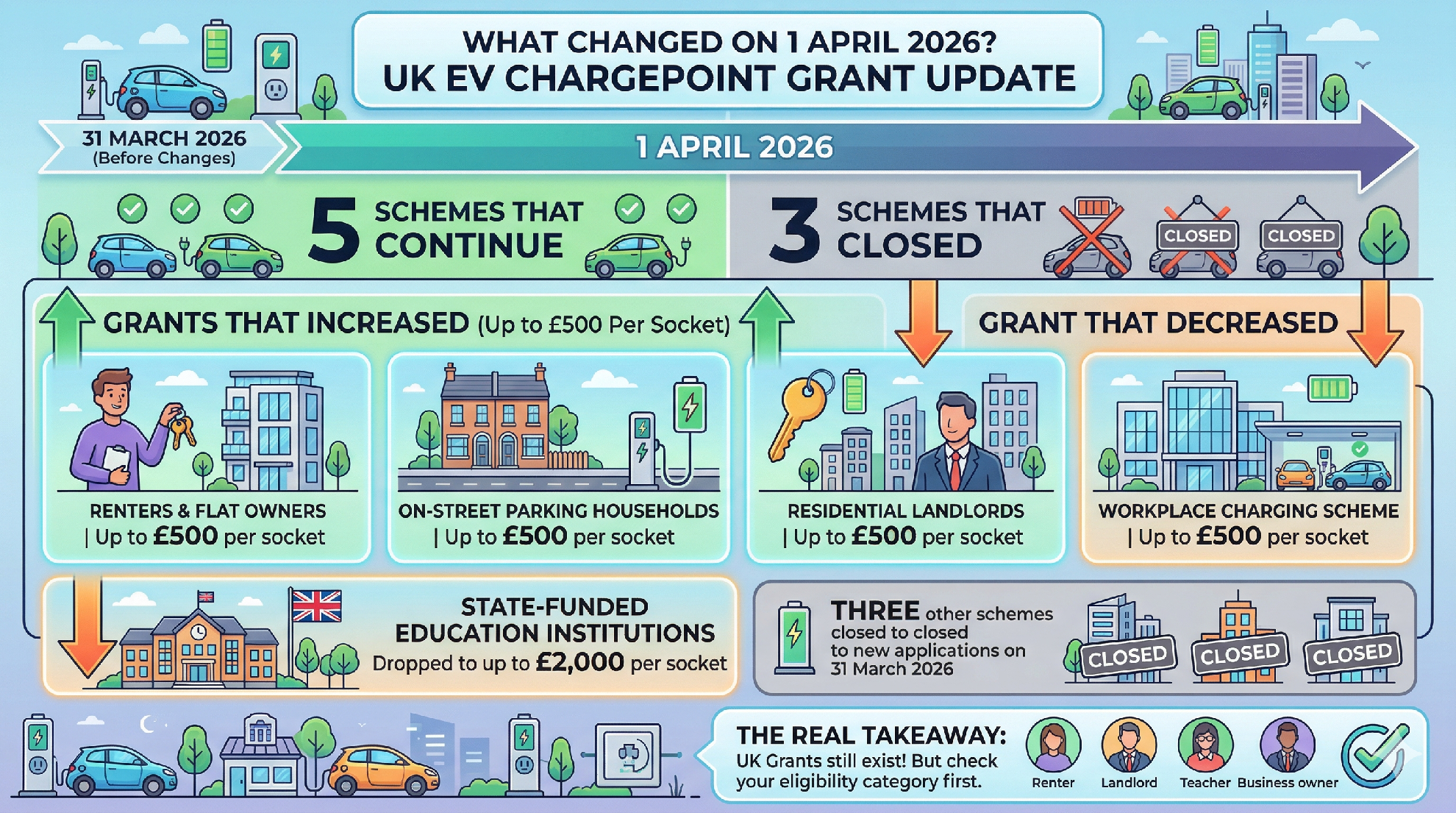
From 1 April 2026, five chargepoint schemes continue until 31 March 2027, but three schemes closed to new applications on 31 March 2026. That means EV charger grants still exist in 2026, but the mix has changed.
The biggest practical changes are these:
- the grant for renters and flat owners increased to up to £500 per socket
- the grant for households with on-street parking increased to up to £500 per socket
- the residential landlord chargepoint grant increased to up to £500 per socket
- the Workplace Charging Scheme increased to up to £500 per socket
- the grant for state-funded education institutions dropped to up to £2,000 per socket
- three other schemes closed to new applications on 31 March 2026
For most readers, the real takeaway is simple: the UK still supports EV charging through grants, but you now need to know exactly which category you fall into before assuming you qualify.
EV grants still available from 1 April 2026
If you want the fastest possible answer, this is the current position from April 2026 onwards.
| Grant | Support from 1 April 2026 |
|---|---|
| EV chargepoint grant for renters and flat owners | Up to £500 per socket |
| EV chargepoint grant for households with on-street parking | Up to £500 per socket |
| Residential landlord chargepoint grant | Up to £500 per socket |
| Workplace Charging Scheme | Up to 75% of eligible costs, capped at £500 per socket |
| Workplace Charging Scheme for state-funded education institutions | Up to 75% of eligible costs, capped at £2,000 per socket |
This is the core of the 2026 story. The grants that remain open are not identical, and they do not target exactly the same type of applicant. That is why a good guide should not stop at the table. It needs to explain how the rules apply in real life.
Which EV grants closed on 31 March 2026?
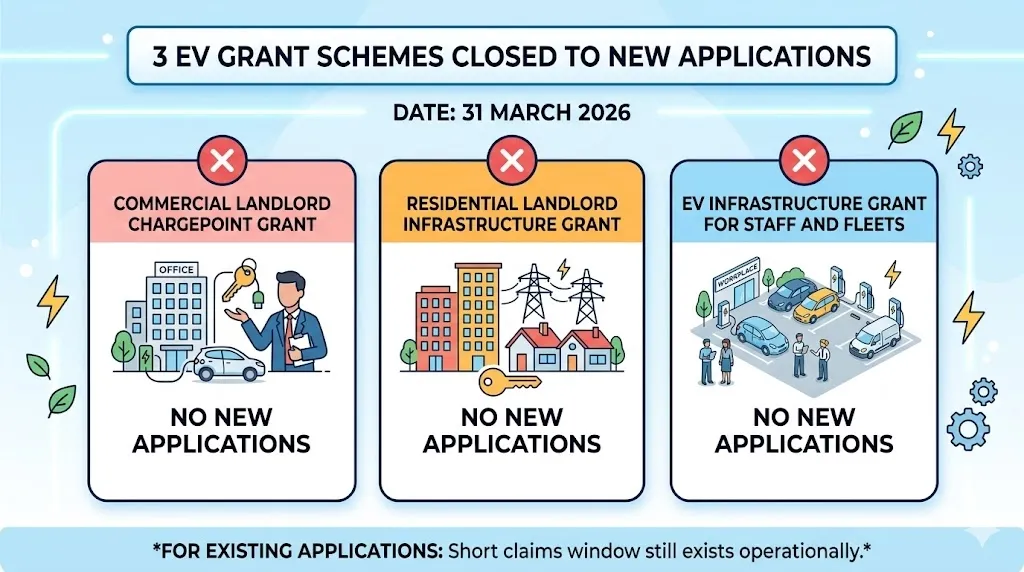
Three schemes closed to new applications on 31 March 2026:
- the commercial landlord chargepoint grant
- the residential landlord infrastructure grant
- the EV infrastructure grant for staff and fleets
This is one of the most important updates for April 2026. It changes the meaning of a lot of older grant content. A page that says “landlord grants are available” without separating residential chargepoint support from the schemes that closed is no longer clear enough.
There is still a short claims window for applications already made under those closing schemes, which matters for installers and applicants already in progress. That detail is useful operationally, but for most new readers the headline remains the same: those three schemes are closed to new applications from April 2026 onwards.
Home EV grants in 2026
The biggest confusion around EV grants usually happens at home charging level. Many people still assume there is a broad home charger grant for any homeowner installing a charger at home. That is not the right way to describe the position from 1 April 2026.
Grant for renters and flat owners
This is now one of the main domestic grants to understand. It applies to people who rent a residential property, or who own and live in a flat, provided they have private off-street parking and meet the relevant eligibility requirements.
From 1 April 2026, the support available under this scheme rises to up to £500 per socket. For many readers, this is the clearest example of how the April 2026 changes reshape the market. Support still exists, but it is no longer framed as a blanket domestic charger grant for every household.
This grant is especially important for people living in blocks of flats, leasehold settings, or rented homes where charger access can otherwise feel more complicated. For those readers, content that combines grant guidance with practical charger advice is likely to perform well because it answers both the funding question and the next decision.
If the reader is ready to move beyond eligibility and into product choice, the next step should feel natural rather than pushy. Relevant internal routes include EV chargers for rented homes, home EV chargers and EV charger installation.
Grant for households with on-street parking
This is the other major domestic scheme that deserves real explanation in 2026. It is designed for households that do not have private off-street parking and are installing a permanent cross-pavement charging solution.
That permanent element matters. This is not simply a grant for trailing a cable across the pavement or using a temporary cable protector. The scheme is intended for a proper cross-pavement setup that becomes part of the charging arrangement. In practice, that means readers need to understand both the charger side and the property or highways approval side before they do anything else.
From 1 April 2026, this grant also rises to up to £500 per socket. That makes it one of the most important developments for drivers who want home charging but do not have a driveway.
This section is also a good place to help the reader understand that having “on-street parking” does not automatically mean they qualify. They still need the right kind of installation route and the relevant permission in place. A strong article should make that distinction clearly so people do not waste time or money assuming they are covered when they are not.

What about homeowners with a driveway?
This is the question many readers will actually be asking, even if they search more generally for “EV grants”. In most cases, owner-occupiers living in a house with private off-street parking will not see the same kind of live mainstream domestic grant support that renters, flat owners and eligible on-street households can access from April 2026.
That does not mean the article becomes less useful for them. It just means the content needs to pivot helpfully. Once a reader realises there may not be a live grant for their situation, the next questions become practical. Which charger should they buy? What does installation usually involve? Do they need load balancing, solar integration or a tethered cable?
That is where strong internal linking matters. Good next-step pages here include best EV chargers in the UK, best EV charger for home in the UK and EV charger installation cost.
Landlord EV grants in 2026
Landlord support still exists after 31 March 2026, but it needs to be described carefully. The residential landlord chargepoint grant remains open, and from 1 April 2026 the support increases to up to £500 per socket.
At the same time, two other landlord-related routes are no longer open to new applications: the commercial landlord chargepoint grant and the residential landlord infrastructure grant. This is exactly the kind of detail that outdated pages will blur together, which is why a new April 2026 guide has a genuine chance to outrank weaker content.
For readers in this category, the article should explain that “landlord support remains” is true, but only if it is paired with the right scheme name and the right type of property situation. That clearer wording improves both accuracy and trust.
Business and workplace EV grants in 2026
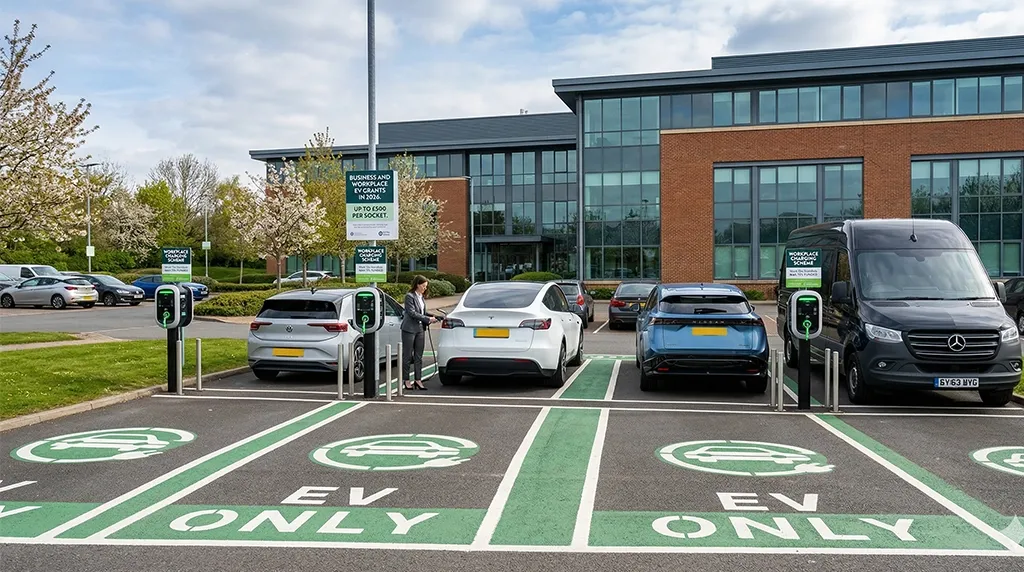
The Workplace Charging Scheme remains one of the most relevant live grants from 1 April 2026. It is aimed at businesses, charities, public sector organisations and small accommodation businesses that want to install EV chargers for staff or fleet use.
From 1 April 2026, the cap increases to up to £500 per socket, while the scheme continues to support up to 75% of eligible purchase and installation costs. For many organisations, that keeps workplace charging one of the most accessible funded routes still live in 2026.
This part of the article should not just repeat the headline number. It should also explain why the scheme still matters. Businesses are often deciding between doing nothing, installing a small number of chargers now, or planning a wider phased rollout. A clear grant guide helps them understand whether a workplace scheme still supports the first stage of that process.
For commercial readers, the best transition is towards charger selection, site planning and installation considerations. Relevant LAMPS pages include commercial EV chargers, best commercial EV chargers and EV charger installation.
School and education EV grants in 2026
State-funded schools and other eligible state-funded education institutions still have a dedicated route after 1 April 2026, but the support level has changed. The scheme remains open, yet the maximum amount available per socket is lower than before.
From April 2026 onwards, the cap is up to £2,000 per socket rather than the previous higher level. That means this is still a live funding route, but schools and trusts reviewing projects in April and beyond need to work from the new number rather than older guidance.
This section can work especially well if it is written in a practical way. Schools are not just asking whether a grant exists. They are often asking whether the project is still worth doing, how many sockets to install first, and whether staff-only charging or visitor charging makes more sense. A useful guide should help frame those questions.
LAMPS already has a closely related internal page on EV charger grants for schools in the UK, which makes a strong internal link from this main guide.
Application changes from 1 April 2026
The April 2026 changes are not just about eligibility and grant amounts. The application process also changed for some schemes, especially those involving renters, flat owners and residential landlords.
That matters because readers do not just want to know whether they qualify. They also want to avoid mistakes. A strong guide should make it clear that the grant process now follows the newer application route for the relevant schemes and that applicants should not arrange installation before they have formal confirmation.
This point is more important than it first appears. One of the easiest ways to create frustration is to let a customer assume they can order a charger, book installation and sort the funding afterwards. Good content should protect against that mistake by spelling out the sequence clearly.
Other EV grants worth including in a broader 2026 guide
If the aim is to rank for broader searches around “EV grants”, it is worth briefly mentioning that charger grants are not the only type of EV support people may be searching for.
Electric Car Grant
The Electric Car Grant is separate from charger funding. It relates to eligible new electric cars rather than chargepoint installation. Including a short section on it helps the page answer broader intent without confusing the main focus of the article.
There is a simple reason to include this. A lot of users searching for EV grants are not yet clear whether they mean a charger grant, a car purchase grant, a workplace grant or something else. A brief explanatory section improves usefulness and can help the page capture wider search demand.
Depot Charging Scheme
It is also worth noting that depot-focused charging support exists for certain larger commercial and fleet situations. This is not the same thing as the standard workplace scheme, and it is more relevant for depot-based fleets, vans, coaches or HGV operations than for ordinary staff parking setups.
You do not need to turn this article into a fleet-only piece, but including a short section acknowledges that some commercial readers will be comparing different funding routes and need to know that workplace charging is not the only option in the market.
Scotland-specific funding
Regional funding routes in Scotland are also worth a brief mention, especially for domestic readers who may come across separate Scottish support through Energy Saving Trust. The key thing is to present those as additional regional schemes rather than as standard UK-wide rules.
What this means in practice
The biggest mistake in EV grant content for 2026 is being too vague. A page that simply says “there are still EV grants available” is not useful enough. The better approach is to help readers identify their situation immediately.
In practice, most readers fall into one of these groups:
- renter with private parking
- flat owner with private parking
- household with on-street parking and no driveway
- residential landlord
- business or workplace applicant
- school or education institution
- homeowner with a driveway but no live grant route
That final group is particularly important because it is easy to disappoint them if the page is not honest. If a reader is unlikely to qualify for a live charger grant, the article should say so clearly and then help them with the next decision rather than leaving them stuck.
This is where the page can convert naturally. Once the funding question is clear, the next need is usually charger choice, installation planning or cost understanding. That creates a natural path into home EV chargers, commercial EV chargers, EV charger installation and contacting LAMPS.
FAQs
Are EV charger grants still available in the UK after 31 March 2026?
Yes. EV charger grants are still available after 31 March 2026, but they are more targeted than many older guides suggest. Support remains for renters and flat owners, households with on-street parking, residential landlords, workplaces and state-funded education institutions.
Is there still a home EV charger grant for homeowners with a driveway?
In many cases, no. From April 2026, the main live domestic routes are focused on renters, flat owners and households with on-street parking using a permanent cross-pavement solution. That means many owner-occupiers living in a house with private off-street parking will not have the same kind of live mainstream domestic grant route.
What EV grants closed on 31 March 2026?
The commercial landlord chargepoint grant, the residential landlord infrastructure grant and the EV infrastructure grant for staff and fleets closed to new applications on 31 March 2026.
Is the Workplace Charging Scheme still available in 2026?
Yes. The Workplace Charging Scheme remains available in 2026 and continues to support eligible organisations with the cost of installing chargepoints, with the cap increasing to up to £500 per socket from 1 April 2026.
Can I install the charger before my grant is approved?
No. Applicants should not treat grant approval as automatic. The safer approach is to complete the eligibility and approval steps first, then move to installation once the grant route is confirmed.
Should this page include electric car grants too?
Yes, briefly. Many people searching for EV grants are not distinguishing between charger grants and car purchase support. A short section on the Electric Car Grant helps the page answer broader intent without losing focus.
Final thought
The best EV grants page for April 2026 is not the one with the longest generic list. It is the one that makes the new position obvious straight away: some grants ended on 31 March 2026, several important schemes still continue, and eligibility now depends much more clearly on the reader’s exact situation.
If the article does that well, it has a much better chance of ranking for current searches, winning trust with real readers and moving them naturally towards the next step, whether that is choosing a charger, planning an installation or getting advice on the right setup.
For that next step, readers can explore the best EV chargers in the UK, compare home EV chargers, review commercial EV chargers or contact LAMPS for help with charger choice and installation planning.